Cash drawer & shift report
At the end of a shift, the person leaving the desk counts the cash. Zitlin says what should be there, they say what is, and the difference is recorded against their name.
That difference is the whole feature. Everything else on these screens exists to explain how the expected figure was arrived at, so the person counting can tell a mistake from a discrepancy.
When more than one person works the same shift, the shift report rolls their drawers into one document — what the property took, and who moved it.
Needs staff sign-in, and your shifts set up
A drawer belongs to a person, so Require staff sign-in has to be on first — see Staff sign-in. Without it there is nobody to hold answerable, which is the only question a cash count answers.
Your shifts are set up by Zitlin, once, when the feature is switched on. Until they are, a drawer cannot be opened at all.
What it is not
It is not the night audit. The night audit closes a day and runs once, usually overnight. A cash drawer closes a shift and runs every time somebody hands over — three times a day at a property working three shifts. The two are independent: closing one never closes the other.
It is not bookkeeping. Nothing here posts to an accounting ledger. It answers one question — is the money actually in the till — and stops.
Your shifts
A shift is a named period of the day: Morning, Afternoon, Night, or whatever your property calls them. Zitlin sets the list for you, with a start time for each, when the feature is turned on. Tell your Zitlin contact how many shifts you run and when they start.
Two things follow from that list, and they are the reason it exists:
- Every cash bag joins one of them, chosen when it is opened. That is what lets several drawers on the same shift be reported together.
- The right one is already picked when a drawer is opened, from the clock. The cashier is confirming, not deciding.
The names are fixed rather than typed. A typed name groups by exact spelling, so "Morning", "morning" and one bad morning's typo become three different shifts that no report can put back together.
Changing your shifts later
Ask, and Zitlin changes the list. Bags already closed keep the name they were opened under, so renaming a shift makes its earlier days harder to find — worth doing once, early, rather than twice.
Opening a shift
The first person on tapes the drawer shut, counts what is already inside, and opens their shift with that figure.
Cash drawer, from the main menu, or the till icon in the shift banner.
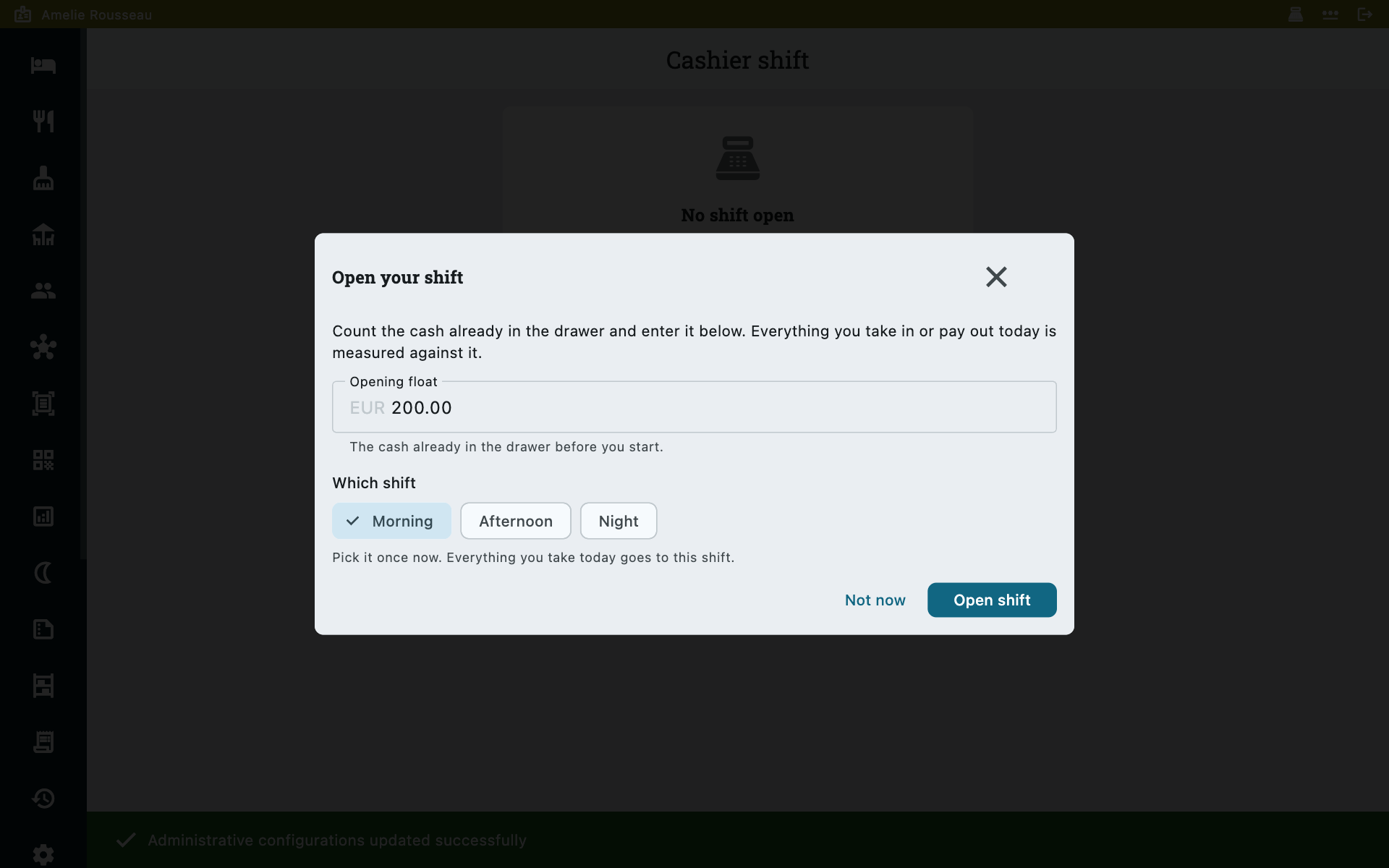
| Field | Notes |
|---|---|
| Opening float | The cash already in the drawer before you start. Pre-filled with your property's standard bag float — confirm it against what is actually in the drawer rather than trusting it. |
| Which shift | One of your property's shifts, pre-selected from the clock. Tap another if you are opening early or late. |
Count the float, don't skip it
Every figure at the end is measured from this one. A shift opened with the float left at zero will report a surplus of exactly the float when it closes, every time — which is why Zitlin never opens a shift for you.
One drawer, one person
Zitlin allows one open shift per person, and several people can have one at once. A hotel with a front desk and a restaurant till runs two side by side, counted separately, each answerable to whoever holds it.
Two people sharing one physical drawer is the one arrangement no software can help with: the difference at the end belongs to nobody. Two people working one shift is fine and normal — they take a bag each, and the shift report adds them up.
Opened the wrong shift?
Change shift on the drawer screen moves an open bag to another shift. It only works while the bag is open — once it is counted and closed, it stays where it is.
During the shift
The drawer screen shows what has passed through it so far.
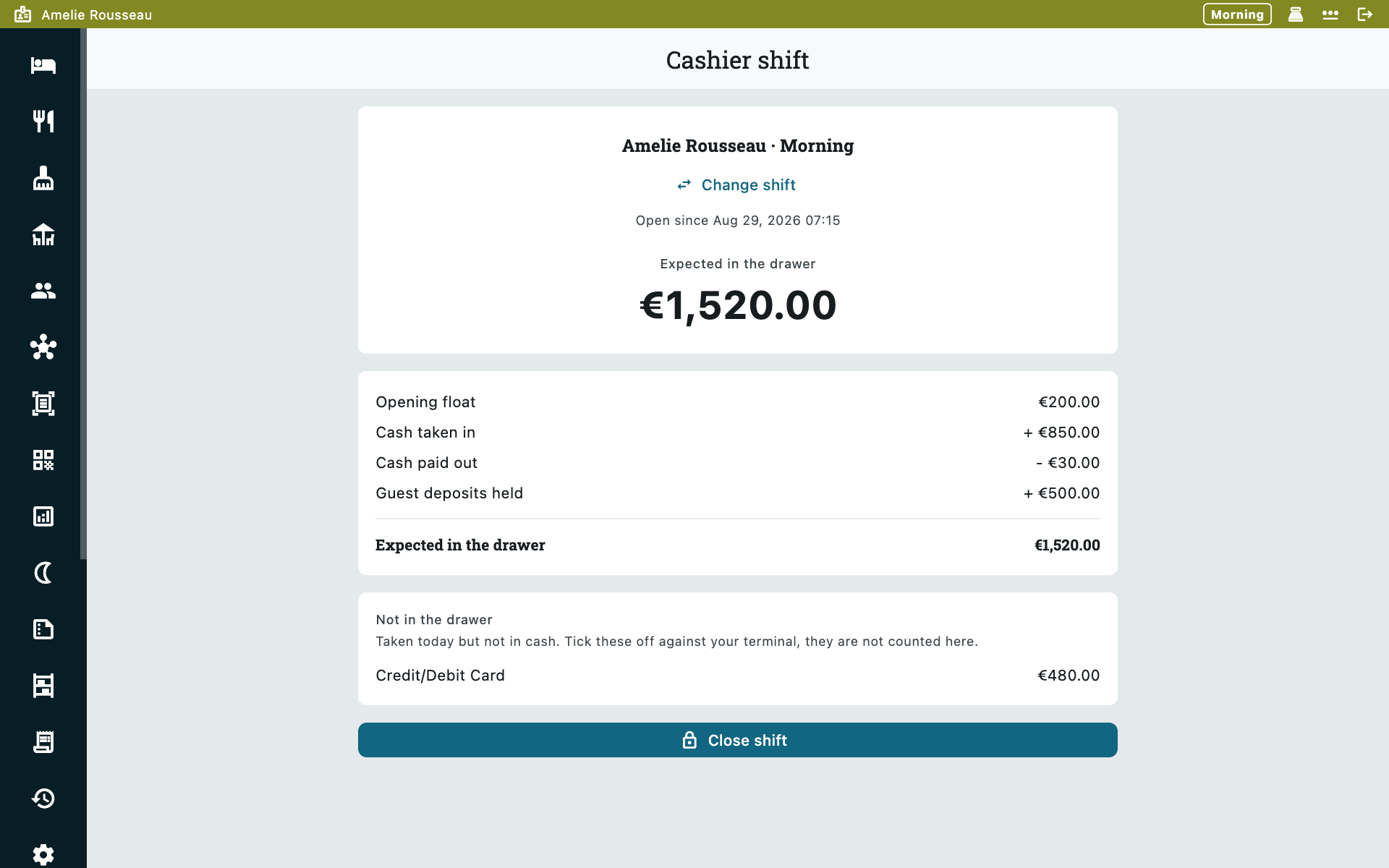
Opening float            200
Cash taken in           +850
Cash paid out            -30
Guest deposits held     +500
─────────────────────────────
Expected in drawer     1,520

Not in the drawer
Card                     480
Cash taken in is prepayments, bills settled in cash, and event-space cash payments. Cash paid out is expenses paid in cash from the till.
Security deposits are counted but not collected. A cash deposit is in your drawer, so it is part of what you are expected to have; it is the guest's money, so it is not part of what the property took. It gets its own line for that reason — the four rows above the rule are what make the total below it, and without it the column would not add up. Returning a deposit takes it back out again, and the line can run negative on a shift that gave back more than it took. A card pre-auth appears nowhere at all — no money moved.
The Guest deposits held line appears only when there is something on it, so a property that takes no deposits sees the same three rows it always has.
Card, UPI and transfers are shown but never counted. No drawer moves when a guest taps a card, so they carry no difference — they are there to tick off against the card terminal's own batch total.
A backdated expense still leaves today's drawer
Pay last month's electricity bill in cash today and it keeps its own bill date for the accounts, but the money leaves today's till. Both readings are correct at once, and the drawer is the one that has to match the notes in your hand.
Closing a shift
Close shift, then count.
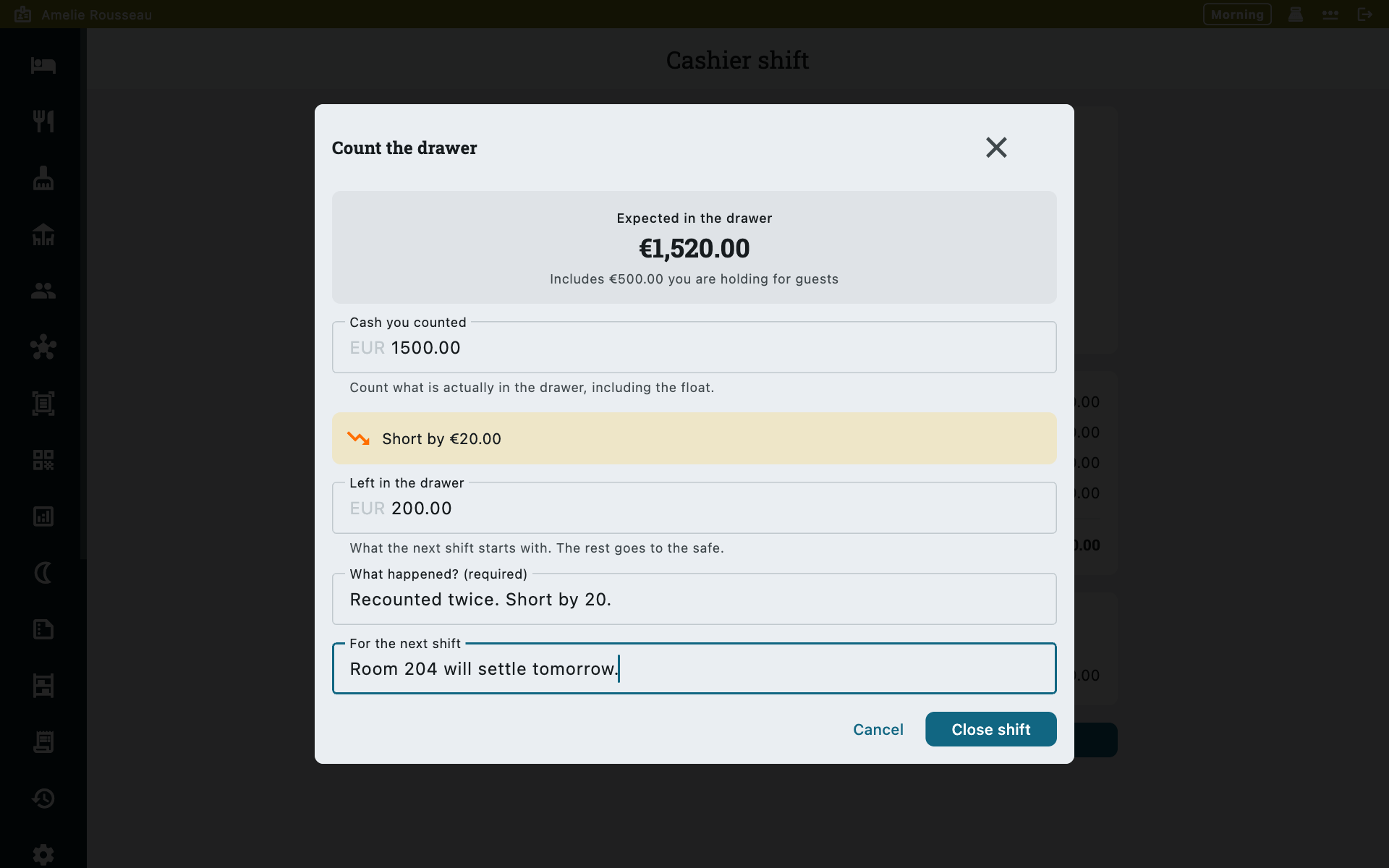
| Field | Notes |
|---|---|
| Cash you counted | Everything physically in the drawer — float and any guest deposits included. If you are holding deposits, the expected figure says so underneath it. |
| Left in the drawer | What the next shift starts with. The rest goes to the safe. Pre-filled with this shift's float. |
| What happened | Required whenever the count does not match. |
| For the next shift | Optional handover note — "Room 204 will settle tomorrow". |
The difference appears as you type, not after you commit.
| Result | Means |
|---|---|
| Balanced | The count matched. Nothing to explain. |
| Short by … | Less in the drawer than expected. |
| Over by … | More in the drawer than expected. |
A drawer that doesn't balance is never blocked
Zitlin records the difference and closes the shift. It does not ask you to try again, and it does not refuse. The point is the record, not the veto — a system that argues with the count just teaches people to type a number that agrees with it.
A note is required when the figures differ, because "why" is the part nobody remembers three weeks later.
What a closed shift will not do
Once a shift is closed, its figures are frozen and no money can ever be added to it. Anything recorded afterwards — even backdated — belongs to whatever shift is open at the time.
That is deliberate, and it is what makes the count trustworthy:
- Editing an invoice a week later does not quietly change what somebody was asked to stand behind.
- A late payment lands in the next person's drawer, which is where the cash actually went.
- Nothing is locked. Reports stay live, bookings stay editable, and the closed shift simply stops being a place money can land.
A bill that was paid into a drawer somebody has already counted cannot be voided, un-settled or re-priced any more. Zitlin says whose drawer it was and when it was closed. Correct it against the current shift instead — the money was counted and signed for, and rewriting it afterwards would leave the signed report disagreeing with the bill behind it.
Voiding a bill that was paid into a drawer still open
The drawer shows both halves: the money came in, then it went back out again. It does not quietly forget the payment, because the cash really did cross the counter — and if it was handed back, the drawer has to say so.
The shift report
Shift report, from the main menu — Admin, Accountant, Rooms Manager and Restaurant Manager.
One shift, one date, every bag on it. Where the drawer screen answers "is my till right", this answers "what did the property take between seven and three, and who moved it".
| Section | What it answers |
|---|---|
| Total collected | Everything taken on this shift, cash and electronic together. Money collected, not revenue earned — a prepayment is collected today and earned later, so it will not match the revenue report. Security deposits are excluded: they are not the property's money. |
| Cash / Card, QR and transfers / Paid out | The same total split by where it went. Only the cash line is counted against a drawer. |
| Not collected | Comped, billed to a company, or taken by the OTA. Recorded, never banked. |
| Security deposits | Custodial money in and out over the shift. Counted in each bag's expected cash, never in the collected total. |
| By staff | How much each person moved, and by which method. |
| Cash bags | One row per drawer: expected, counted, and the difference. |
| Transactions | Every movement in order, with the time, the guest or table, the method and the name. |
Provisional or Complete. The report is Complete only once every bag on the shift is closed. While one cashier is still working, the totals will still move — which is what stops a duty manager signing off a shift at 14:10 that gains another ₹400 at 14:20.
Export as PDF produces the same document for a file or an email.
A worked example: two clerks, one Morning shift
Priya opens the desk at 07:00. At 11:00 Daniel joins her for the busy check-out hour and takes a bag of his own. Both are on Morning.
| Opening float | 2,000 |
| Deposit, room 204, cash | +6,000 |
| Bill settled, room 111, cash | +4,500 |
| Bill settled, room 108, card | +12,400 |
| Plumber call-out, cash | −600 |
| Expected in drawer | 11,900 |
| She counted | 11,900 |
| Difference | Balanced |
| Opening float | 2,000 |
| Deposit, room 302, cash | +3,000 |
| Bill settled, room 217, cash | +1,500 |
| Bill settled, room 220, UPI | +4,200 |
| Expected in drawer | 6,500 |
| He counted | 6,440 |
| Difference | Short by 60 |
Daniel's note: "Recounted twice. Gave change from the wrong pile at check-out."
At 15:15, with both bags closed, the duty manager opens Shift report → Morning → today and reads it top to bottom:
Morning · 12 August                              Complete

Total collected                                   31,600

  Cash                                            15,000
  Card, QR and transfers                          16,600
  Paid out                                           600

By staff
  Priya                                           22,900
  Daniel                                           8,700

Cash bags
  Priya    Counted     Expected 11,900   Counted 11,900
  Daniel   Counted     Expected  6,500   Counted  6,440
Four things they now know, none of which needed a phone call:
- The shift took 31,600, of which 15,000 was cash they can go and count in the safe.
- Priya moved 22,900 and Daniel 8,700 — so the desk was busier before eleven, which is a rota question, not a money one.
- Daniel is 60 short and Priya is exact. The difference belongs to one named person on one named bag, not to "the front desk".
- Daniel already said why. The note travels with the bag, so the conversation at 15:15 starts from an explanation rather than an accusation.
If they had opened the report at 14:30, while Daniel was still serving, it would have said Provisional and shown his bag as Still open — correct, and not yet something to sign.
Cash the clerks can see, counts they cannot
A clerk who held a bag on the shift can open this report too, but sees the shift's totals and only their own bag. "What did we take" is the property's number; "who came up short" is a supervisor's question, and a clerk holding a till is exactly who it is being asked about.
Reviewing past counts
Shift history, from the report's toolbar — the same four roles.
Pick a date range, then filter to Did not balance to see only the shifts that came up short or over. That filter is the point of the screen: scanning a list of zeros is exactly the work the feature is meant to remove.
Each row shows who held the drawer, when it ran, what they counted, the difference, and their note.
Somebody went home without closing
An Admin can close a drawer on their behalf: open the shift from the history and Close it for them. The shift keeps its original owner — only the "counted by" line names the manager — so the difference stays attributed to whoever actually ran the till.
A drawer left open from an earlier day is sealed by the night audit instead, without a count. It shows as Never counted rather than as balanced, because nobody counted it and a zero difference would claim somebody had.
Making it compulsory
Settings → More → Staff → Require an open cash drawer
Off by default. Once on, no payment can be recorded until the person taking it has opened a shift; they are prompted to open one and the action then completes on its own.
That includes cards and transfers, not just cash. A card moves no drawer and has nothing to count, but a payment recorded with no bag open belongs to no shift and so appears in no report, ever — and a shift report that quietly omits the card machine is not a report of what the property took.
Leave it off unless you need it
A guest standing at the desk with cash should never be refused for a bookkeeping reason — the clerk takes the money anyway and records it later, or wrong, which manufactures exactly the untracked cash the feature exists to catch. Most properties get what they need from the prompt and the unassigned figures alone.
Where it is off, money recorded with no shift open is still recorded — it just belongs to nobody, and shows up that way for a manager to chase.
Common questions
Do I have to use this to use Zitlin?
No. It is off until you turn staff sign-in on, and a property that takes little cash can ignore it entirely. It earns its keep where cash is a meaningful share of takings and more than one person handles it.
Somebody forgot to open a shift and took ₹4,000 in cash
The money is recorded — the payment went through normally. It is simply not attached to a drawer, and appears as unassigned when a manager reviews the period. Opening a shift afterwards does not retroactively claim it.
Two people worked the same shift. Do they share a drawer?
No — a bag each, both on the same shift. The shift report adds them up and still shows each drawer separately, so the shift's takings and each person's count are both answerable. One physical drawer shared by two people is the arrangement to avoid: the difference at the end belongs to nobody.
Can I count card takings too?
They are shown, but not reconciled. A card batch settles on the acquirer's schedule rather than yours, so a figure counted at 3pm rarely matches anything. Tick them off against your terminal; only cash carries a difference.
The drawer was short and we found the mistake an hour later
Leave the closed shift alone — it records what was true at the time, which is the honest answer. Fix the underlying record (the mistyped prepayment, the missed bill) and the correction lands in the current shift.
Why won't Zitlin let me void this bill?
Because it was paid into a drawer somebody has already counted and closed. Voiding it would change a figure the property has signed for. Raise the correction against the current shift instead.
The report says we collected more than the revenue report
They measure different things, and both are right. The shift report counts money that arrived; the revenue report counts revenue earned. A prepayment taken in March for an August stay is collected in March and earned in August.
Can a waiter open a drawer?
Yes. Waiter and above can hold a till, which is what lets a restaurant run its own. Reviewing other people's counts is a supervisor's job — see Roles & permissions.
My drawer is over by exactly the deposits I took
Then it is not over. Expected cash includes security deposits, because the notes are physically in the till — check you are comparing against the expected figure Zitlin shows and not against the day's takings, which deliberately exclude them.